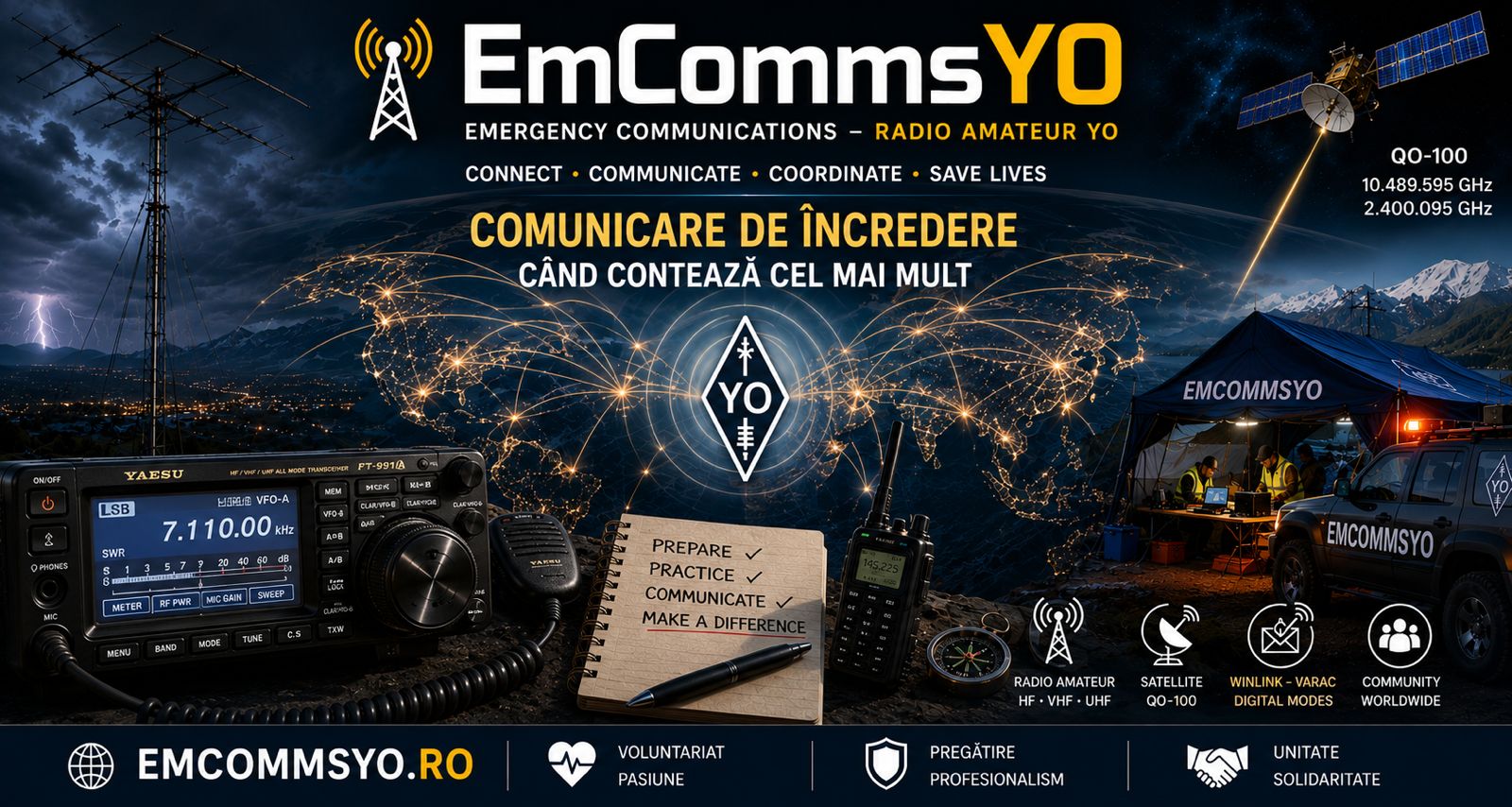
A few years ago, driven by my growing interest in emergency communications — probably a bit of professional deformation from my background as a former Radio Officer and currently a General Operator GMDSS in the maritime mobile service, operating “/MM”, together with various underwater SAR-related activities — I added a dedicated group to my Facebook account: Digital & Emergency Comms HAM Radio by YO4FRF.
The idea was simple: to share information about EmComms and hopefully find other people “on the same frequency”, with similar interests.
Time passed, the group grew, and eventually there was a need for a more interactive place for discussions. That is how we ended up on Telegram, where Digital & EmComms YO HAM Radio gradually developed.
Here we discuss and test a fairly wide range of technologies, modes and communication methods: VarAC, Winlink, JS8Call, CB, PMR, TETRA, DMR, APRS, Mesh, 60 m / 5 MHz, FLDigi, FreeDV, Mercury, power sources, and many others.
Sometimes discussions can get quite lively, but we always try to keep them within the spirit of fair play and with respect for everyone’s experience.
We also have a presentation website, still under development: https://emcommsyo.ro/ 😊
We are not affiliated with any organization and we do not have any legal status as an association or entity. Everything we do is voluntary, within the framework of the Romanian amateur radio regulations and generally accepted good operating practice.
All equipment, activities and resources used in our experiments are funded entirely by ourselves.
Our goal is simple: to test and experiment with communication methods — predominantly digital ones — that could prove useful when conventional communication infrastructures are unavailable, disrupted or degraded.
And we do not test them only “on paper”.
We carry out practical tests regularly, in summer and winter, day and night, under different propagation conditions — preferably when conditions are as unfavourable as possible.
Sometimes the results surprise us.
Sometimes they are very good.
Sometimes… absolutely nothing works. 😁
The Sun King is always watching over us!
Along with a few somewhat less… “orthodox” power sources.
We also take part in recurring international activities and tests, such as VarAC on HF every Wednesday and APRS Thursday.
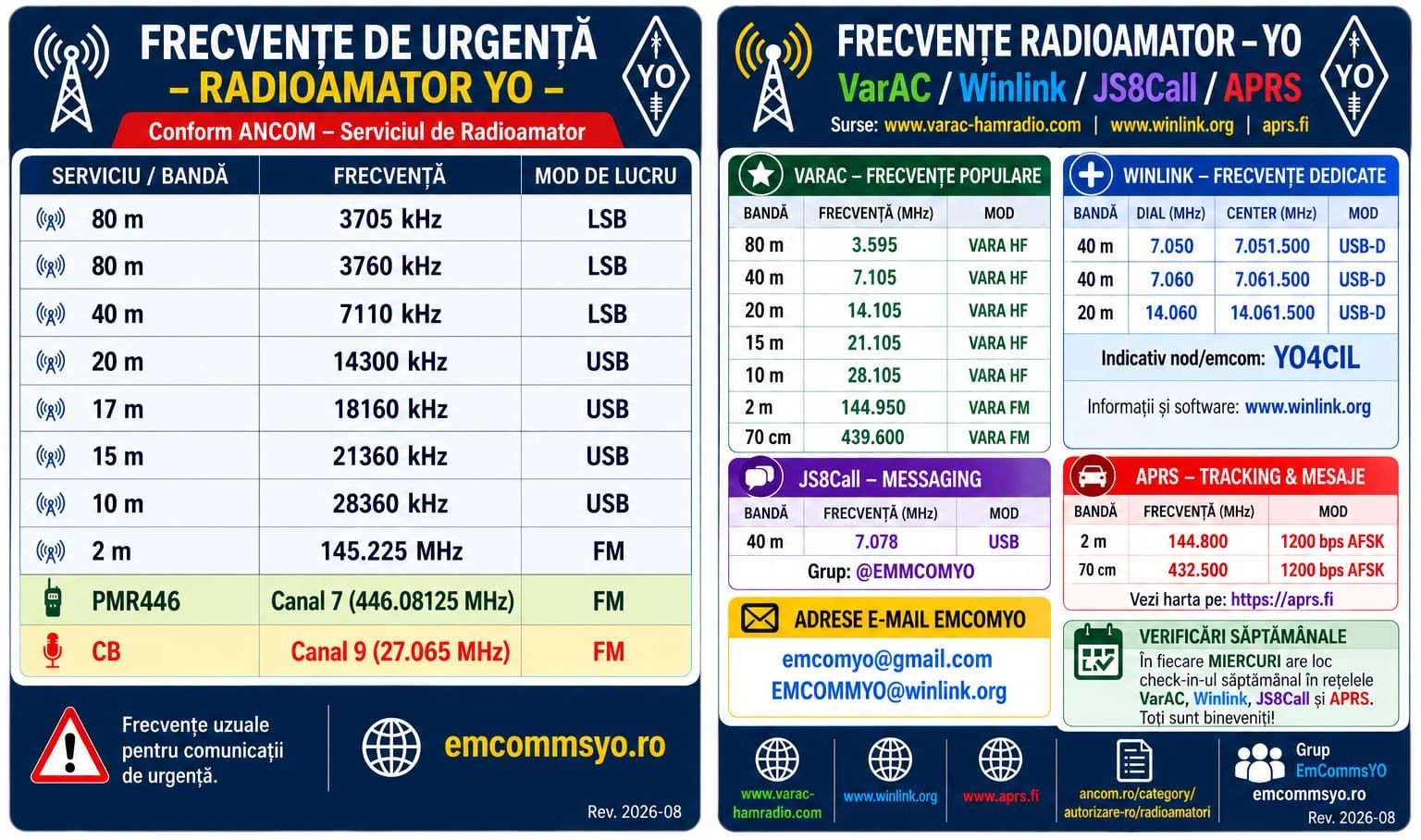
Note: this information page may be updated or modified over time.
Apart from these activities, we run tests among ourselves whenever we have the time — or simply whenever we want to find out:
- how well a new antenna performs;
- how a new operating mode behaves;
- what a new software update actually brings;
- how propagation behaves under poor conditions depending on our antennas and operating location/QTH — fixed, portable or mobile.
We contact each other through the dedicated Telegram channel, see who is available, and then go on the air.
We adjust software settings and radio parameters, modify antennas, change operating modes, compare results and enjoy every small step forward.
We try to remain practical and realistic: how do we communicate when the situation actually requires it?
Obviously, without replacing, interfering with or disrupting the official communication systems and channels used by public authorities during emergencies.
What we are trying to build is an additional layer of communications resilience and redundancy — a last backup, if you like. 😎
Whether we are talking about local communications on VHF/UHF, CB or PMR, HF communications on 40 or 80 metres, voice or digital modes, whether local repeaters are operational or not, or whether radio kits — HF/VHF radios, batteries, antennas and associated equipment — are available in a vehicle, in a backpack or deployed in the field, we try to consider as many realistic scenarios as possible.
Without relying exclusively on terrestrial or mobile voice and data networks.
We bring together everyone's experience, test different solutions, compare the results and continuously try to improve our procedures and our ability to communicate.
Every participant brings his or her own ideas and practical experience.
We try to learn from one another and, in particular, from those who have already been through more real-world situations, field tests and operational scenarios than the rest of us.
Natural and meteorological events, as well as various social situations over the past twenty years, have provided more than enough practical examples of why alternative and redundant communication options may be necessary.
If you are interested in Emergency Communications in Amateur Radio — EmComms, you are welcome to join us.
Until then, all the best, and hopefully we will hear each other on the air.
Let us keep testing, experimenting and learning — and let us hope that we will never actually need to use, in a real emergency, what today we only test and simulate.
73 de YO4FRF/MM