
CN UUS 2026
After the publication of the 2025 results, when our team won both the VHF and UHF categories (144 and 432 MHz), enthusiasm among potential participants in the 2026 edition, as possible operators of the club callsign, increased considerably. We had already received several confirmations of participation. But once again, life proved that plans and good intentions are no substitute for certainty. So, out of the many “confirmed” participants, in the end there were only two operators — the same two as every year: Cornelius YO4DW and Dan YO4FPF.
We started checking the setup as early as July, beginning with the antennas, after they had undergone some repairs and improvements to the driven element of the 144 MHz antenna. The repairs carried out by Costin YO4YPC proved to be very good, and we had no problems with either antenna.
We dealt only with the part we know best: 144 and 432 MHz. The 1296 MHz and higher bands were handled by Liviu YO4FNG, who owns all the equipment and antennas used there.
On August 12, we brought all the equipment needed for the contest to Dan’s place. With the inventory list in front of us, we checked everything we considered to be the minimum equipment required for this year’s participation.
On Saturday morning, at 07:20, we left for Crucea, Constanța County, heading to the location we had been using for many years. Everything went smoothly on the way there; the E60 was clear, with little traffic in our direction.
When we reached the junction with the dirt road, we continued as usual toward the edge of the woods, where the familiar turn-off should have been. But everything was almost unrecognizable. The vegetation had grown very high, and the track previously used by agricultural machinery had been badly damaged by rain, with deep ruts and sections that posed a real risk to normal vehicles. Because of the vegetation, we could barely see where we were supposed to drive.
We decided not to climb up that way and instead continued along the tracks left by agricultural machinery. We drove around the sunflower fields until we found another possible route up to our usual operating site. The road turned out to be quite good, without potholes or impassable sections.
We arrived safely and, after a 20-minute break and a quick reconnaissance of the area, started unloading and setting up camp. In about two hours, everything was in place. Meanwhile, Liviu YO4FNG and Georgica YO4CSG also arrived and began setting up their equipment.
Next came an on-air test of the 144 MHz setup together with Claudiu YO4FYQ in Valu lui Traian. Everything worked perfectly and we were ready to go.
Then the 144 MHz section began.
Compared with last year, QSOs came much more slowly. Almost every station suffered from fading — signals disappeared and then came back again. Participation also seemed considerably lower than the previous year. Many callsigns were either absent or simply never heard.
There were long periods of CQ calls without any response. At times it almost felt as if we no longer had an antenna — we could hear no more than two CW stations on the band, and that was about it.
At 20:59, when we ended our participation on 2 metres, we had logged 73 QSOs. A lot? A few? We will find out when the final results are published.
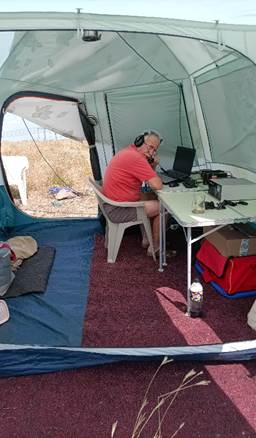
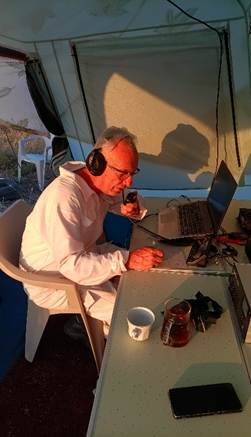
Immediately after the 144 MHz section ended, with night already upon us and working by the light of our headlamps, we took down the 2-metre antenna and installed the one for 70 cm.
We went to rest earlier than last year. At 23:30, when our SHF colleagues decided that the 1.3 GHz section was over for the day, we shut down the generator.
The next morning, wake-up was at 05:30. We had some coffee, grabbed a quick bite, started the generator and tested the setup again with Claudiu.
At 06:00, the 432 MHz contest section began, very much in the same way as the 144 MHz one. We logged 47 QSOs. Again, there were long CQ calls without any reply and long periods of searching across the band without hearing a single call or QSO.
At 10:00, the second 1296 MHz and higher section began, handled by our colleagues. QSOs on bands above 1.3 GHz were simply not possible from this location. With an altitude of only about 230 metres ASL, the site did not allow any contacts on the higher bands.
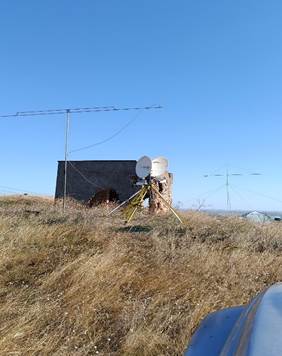
We ended our participation at 11:15. As dismantling of the 2 m and 70 cm setups had already started at 10:20, we were able to leave the contest site at 13:30. The trip back to Constanța went without any problems.
Murphy stayed away this year, so the only real problems were propagation and, to some extent, participation. It seems that participation is decreasing from year to year. Perhaps the atmospheric conditions or the excessive heat played a part.
At our location, however, conditions were quite pleasant. On the first day we had moderate wind and very comfortable weather. During the night, temperatures dropped to around 14°C toward morning, rising to about 26°C by the time we left. Quite acceptable.
Judging by the way the contest went, we believe we should finish among the top three in each category.
Setup used
144 MHz
- TCVR: ICOM IC-7100
- Linear amplifier: 300 W TAJFUN 1000
- Antenna: 10-element LFA DK7ZB
432 MHz
- TCVR: ICOM IC-7100
- Linear amplifier: 200 W TAJFUN 1000
- Antenna: 17-element DK7DZ
1296 MHz
- TCVR: Yaesu FT-817
- Transverter: DB6NT
- Antenna: 50-element antenna
YO4DW Cornelius
YO4FPF Dan